 blog
blog
Best Mist for Skin Barrier Repair: 2026 Guide
Table of Contents
- What Makes a Mist the Best for Skin Barrier Repair?
- How to Hydrate Skin Fast: The Role of Mists in Barrier Recovery
- Skin Barrier Repair Ingredients to Look For (and Avoid)
- Key Features of a Barrier-Repairing Mist: pH, Probiotics, and Packaging
- How to Choose the Right Mist for Your Skin Type
- How to Use Face Mists in Your Skincare Routine
- What to Expect from a Barrier-Repairing Mist
- Conclusion
- Frequently Asked Questions
Last Updated: September 30, 2026
What Makes a Mist the Best for Skin Barrier Repair?
The best mist for skin barrier repair delivers three things at once: humectants that pull water into the skin, soothing agents that calm irritation, and a pH-balanced formula that respects the acid mantle. A fine mist matters too, since even coverage beats a soaking spray every time.
Here's the part most guides skip. A damaged barrier isn't just dry skin. It's a compromised lipid barrier that lets water escape and irritants in, a process called transepidermal water loss.
This guide breaks down what actually repairs that barrier, which ingredients earn their place, and how to fit a mist into a routine you'll stick with.
How to Hydrate Skin Fast: The Role of Mists in Barrier Recovery
Mists hydrate fast because they put water-soluble humectants directly on the skin's surface without the wait of a heavy cream. For a stressed barrier, that instant layer of hydration can calm the tight, reactive feeling within seconds.
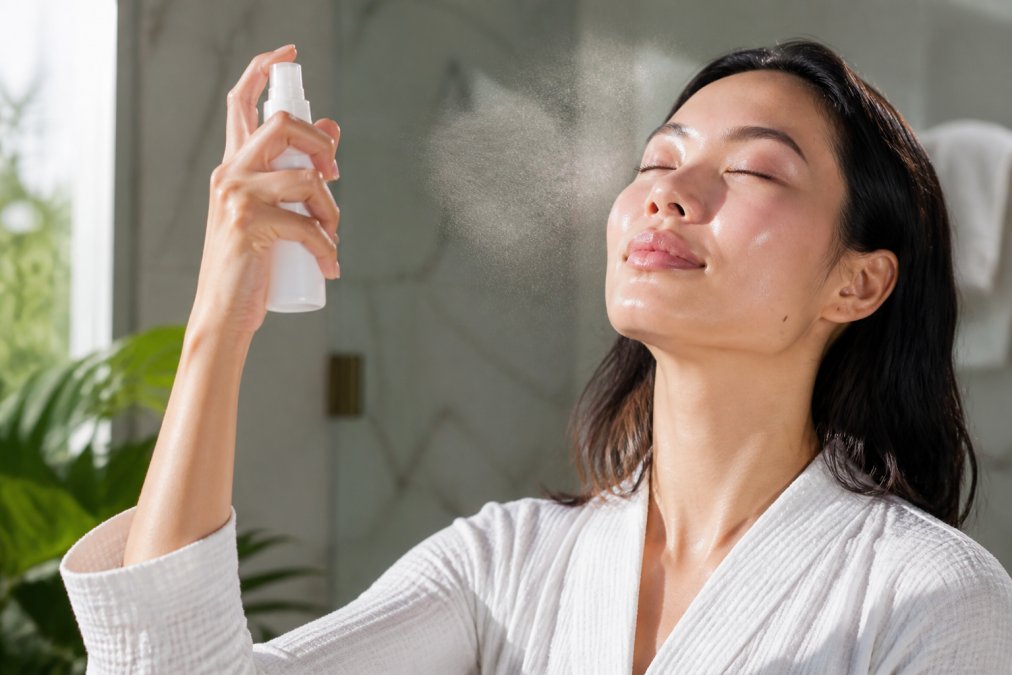
Speed isn't the same as repair, though. A mist buys you comfort while the deeper work happens.
- Humectants like hyaluronic acid and panthenol draw water to the surface
- Soothing agents like centella asiatica reduce visible redness
- Ceramides and peptides support the lipid barrier over time
The mistake is treating the mist as the whole routine. It's the first step, not the last.
Skin Barrier Repair Ingredients to Look For (and Avoid)
Barrier repair ingredients fall into two camps: those that rebuild the lipid barrier and those that calm the inflammation sitting on top of it. You want both, and you want to skip the ones that quietly make things worse.
Look for:
- Ceramides to replace lipids the barrier has lost
- Hyaluronic acid and glycerin as humectants for hydration
- Panthenol and centella asiatica for soothing and anti-inflammatory support
- Peptides to support skin texture over time
- Prebiotics and probiotics to support the skin microbiome
Avoid or limit:
- High concentrations of denatured alcohol, which strips the barrier further
- Added fragrance if your skin is reactive
- Strong exfoliating acids used daily on an already-irritated barrier
Many people find that cutting one irritating ingredient does more for redness than adding three new products.
Key Features of a Barrier-Repairing Mist: pH, Probiotics, and Packaging
A barrier-repairing mist should be pH-balanced, microbiome-friendly, and packaged to protect what's inside. Those three features separate a formula that supports the acid mantle from one that just feels nice for ten minutes. Most guides stop at that sentence. Here's what's actually happening under it.
pH balance and the acid mantle. Healthy skin surface sits at roughly pH 4.5 to 5.5, mildly acidic. That acidity isn't cosmetic; it's an active defense system. The acid mantle is a thin film of sweat, sebum, and skin-derived acids that does three jobs at once: it keeps the enzymes that break down dead skin cells (and build new barrier lipids) working at the right speed, it suppresses the growth of harmful bacteria, and it keeps the lipid bilayer packed tightly enough to slow water loss.
When you spray something alkaline on your face, you temporarily push that surface pH upward. A common pattern is that skin feels "squeaky clean" or "refreshed" for a few minutes and then tight and reactive an hour later, that's the acid mantle rebuffering, and it can take a while. Repeatedly disrupting it is one of the quieter ways a barrier stays compromised even when you're using good ingredients.
This is why a pH-balanced mist is a baseline, not a bonus. Look for formulas stated to sit in the skin-compatible range (roughly pH 4.5 to 5.5). If a brand doesn't publish it, that's information too. A mist that's mostly water plus fragrance may sit near neutral or above, and it will do less for a stressed barrier than a properly buffered one.
Probiotics and prebiotics. These support the skin microbiome, the community of organisms that helps keep the barrier resilient. The distinction matters: prebiotics are the food (often sugars or fermentable compounds) that feed beneficial skin flora, while probiotics are live or heat-treated organisms themselves. In leave-on skincare, most formulas use postbiotics, the fermented byproducts, because they're more stable in a water-based mist than live cultures. Formulas built around them tend to suit sensitive, redness-prone skin, where the microbiome is often out of balance.
Packaging. Airless or well-sealed bottles protect probiotic, prebiotic, and antioxidant ingredients from light and air, which degrade them faster in a watery formula than in a cream. They also let you mist without touching your face, which matters if your skin is reactive, fingers and reused spray nozzles are a common source of irritation for people who are already sensitized.
A practical check: if a mist is sold in a clear bottle on a sunlit shelf, the actives at the top of the ingredient list are probably doing less by the time you finish the bottle. Opaque or airless packaging is a real functional choice, not just a design one.
The sustainability angle is worth a thought too. Refillable and recyclable packaging reduces waste, and it's a fair question to ask of any product you'll repurchase. Refill pods and aluminum or glass formats are increasingly common, and they tend to be the formats that also protect the formula best, so the eco choice and the efficacy choice often point the same direction.
How to Choose the Right Mist for Your Skin Type
Match the mist to your skin type and its main concern, not to the loudest marketing claim. Dry, dehydrated, sensitive, and mature skin each need a slightly different emphasis, and the same skin can shift categories depending on the season, the climate you're in, and what else is in your routine.
| Skin Type | Priority | Ingredients to Favor |
|---|---|---|
| Dry | Lipid support | Ceramides, emollients |
| Dehydrated | Water retention | Hyaluronic acid, glycerin |
| Sensitive or redness-prone | Calming | Centella asiatica, panthenol |
| Mature | Barrier plus texture | Peptides, ceramides, probiotics |
| Oily but reactive | Light hydration, no occlusives | Glycerin, panthenol, niacinamide |
Mature skin often needs hydration and lipid support together, since barrier function tends to weaken with age. If your skin is reactive, patch-test first and introduce one new product at a time.
A common mistake is buying for the concern you read about rather than the one you actually have. Dehydrated skin and dry skin look similar but respond to different ingredients.
A quick decision path:
- Identify your primary concern (tightness, flaking, redness, or texture).
- Note your environment (humid, dry, heated, air-conditioned, polluted).
- Pick one humectant-led mist and, if pollution or redness is a factor, one antioxidant or soothing mist.
- Patch-test on the jawline for three days before full-face use.
- Re-evaluate at the season change, the mist that fit in July may not fit in January.
How to Use Face Mists in Your Skincare Routine
Use a face mist on damp skin, right after cleansing and before heavier products. This is the layering technique that gets the most out of it, because humectants need moisture to pull in and something on top to seal it.
- Cleanse gently and leave skin slightly damp
- Mist evenly from about six inches away, eyes closed
- Press in lightly with clean hands, don't rub
- Follow with a serum while skin is still damp
- Seal with a moisturizer to lock in hydration
- Re-mist midday if skin feels tight
What to Expect from a Barrier-Repairing Mist
Expect immediate comfort and a dewy finish, with visible improvement in tightness and redness over consistent use. A barrier-repairing mist is a support product, not a miracle in a bottle.
Conclusion
Rebuilding a compromised barrier takes patience, and it's easy to get discouraged when results don't show up overnight. The fix is a routine that hydrates, soothes, and stops the stripping, done consistently.
Get started with Coastaltrade.
Frequently Asked Questions
Can a face mist actually help repair a damaged skin barrier?
Yes, if it contains barrier-supporting ingredients like ceramides, panthenol, or probiotics. A well-formulated mist can deliver hydration and soothing compounds that support the skin's lipid barrier and microbiome. Look for pH-balanced, non-comedogenic formulas. Regular use can improve moisture retention and reduce irritation, but it works best alongside a gentle cleanser and moisturizer.
What ingredients should I look for in a mist for skin barrier repair?
Seek out humectants like hyaluronic acid and glycerin to draw in water, emollients like ceramides and peptides to seal in moisture, and soothing agents like centella asiatica and panthenol to calm redness. Pre- and probiotics can support the skin microbiome. Avoid drying alcohols and synthetic fragrances that may further irritate a compromised barrier.
How often should I use a hydrating mist for barrier support?
You can use a hydrating mist two to three times daily, or whenever your skin feels tight or dehydrated. In the morning, mist before moisturizer to boost hydration. In the evening, use after cleansing and before serums. If your skin is very dry, a mist can also be used to refresh makeup without disturbing the barrier.
What is the difference between a refreshing mist and a barrier-repairing mist?
A refreshing mist primarily provides a quick burst of hydration and a cooling sensation, often with minimal active ingredients. A barrier-repairing mist goes further by including ceramides, probiotics, and anti-inflammatory compounds that help rebuild the skin's lipid barrier and microbiome. The latter is formulated to address sensitivity, redness, and transepidermal water loss.