 how-to
Simple Daily Routine for Aging Skin: A 2026 Guide
Table of Contents
- What You'll Need Before You Start
- Step 1: Gentle Cleansing That Protects Your Skin Barrier
- Step 2: How to Reduce Eye Puffiness in the Morning
- Step 3: The Best Ingredients for Aging Skin (and What to Layer First)
- Step 4: Moisturize and Repair Your Barrier Every Night
- Skincare Routine Order for Beginners: Morning vs. Evening
- Common Mistakes to Avoid in Your Aging Skin Routine
- Conclusion
- Frequently Asked Questions
Last Updated: September 28, 2026
What You'll Need Before You Start
Building a simple daily routine for aging skin starts with five basics: a gentle cleanser, a vitamin C serum, a retinoid, a barrier moisturizer, and a broad-spectrum sunscreen. That's it. You do not need twelve steps.
Here's the part most guides miss. Aging skin isn't just "dry skin with wrinkles." After menopause, declining estrogen speeds up collagen loss and thins the skin, so the barrier weakens and dryness sets in faster.
Gather these before you begin:
- Gentle cleanser with a low-pH, non-foaming formula
- Vitamin C serum for daytime antioxidant protection
- Retinoid (start low and go slow)
- Moisturizer with ceramides or peptides
- Broad-spectrum SPF 30 or higher
One rule before anything else: patch test every new active on your inner forearm for two nights. If redness or stinging appears, wait a week and try again at half strength.
Step 1: Gentle Cleansing That Protects Your Skin Barrier
Cleansing is where most aging-skin routines quietly fall apart. Harsh foaming washes strip the lipids that hold water in, and that damage shows up as tightness, flaking, and more visible fine lines.
Use lukewarm water and a cream or gel cleanser, then rinse for twenty seconds. Pat dry with a soft towel. Never scrub.
The American Academy of Dermatology recommends limiting exfoliation and avoiding harsh physical scrubs on mature skin, because the barrier takes longer to recover as you age. American Academy of Dermatology skincare guidance
Cleanse twice daily. If your skin feels tight after washing, your cleanser is too strong.
Step 2: How to Reduce Eye Puffiness in the Morning
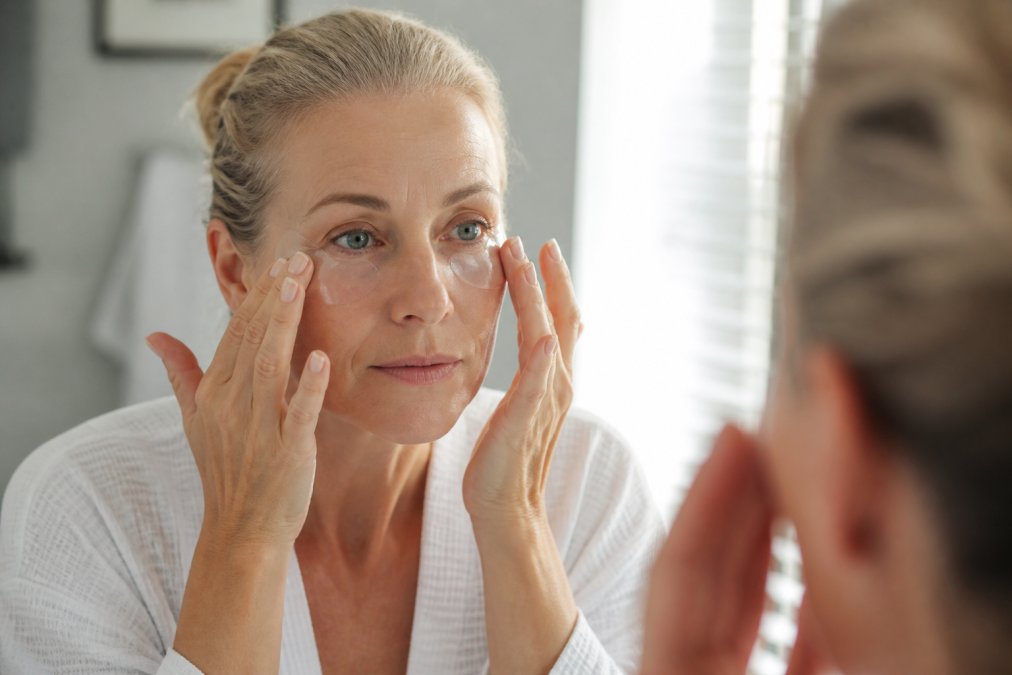
The skin around your eyes is the thinnest on your body, roughly 0.5 millimeters in most adults, and it thins further with age as collagen and elastin decline. That is why puffiness, crepiness, and dark circles show up there first, and why the fix depends on which problem you actually have.
Morning puffiness is usually fluid, not fat. Fluid pools under the eyes overnight, and it is worse when you sleep flat, eat a high-sodium meal late, or wake up after poor sleep. The fix is mechanical and fast:
- Sleep with your head slightly elevated, an extra pillow is enough.
- Rinse your face with cool water for thirty seconds to constrict vessels.
- Apply a chilled eye gel, a cold spoon, or a refrigerated roller for one minute.
- Pat, never rub, the under-eye area, rubbing stretches already-thin skin.
Caffeine-based eye creams can temporarily tighten the surface, but they do not treat the underlying cause. If puffiness is persistent rather than morning-only, it is more likely genetics, fat pad positioning, or a medical issue, and no topical will move it.
Dark circles are a separate problem with three different causes, and each needs a different answer:
- Vascular (blue-purple, worse when tired): thin skin over visible vessels. Caffeine and cold compresses help short-term; a retinoid used at night over several months is the more honest long-term answer.
- Pigmentary (brown, often hereditary or sun-driven): vitamin C in the morning plus daily sunscreen. This one responds slowly, expect eight to twelve weeks.
- Structural (shadowing from a tear trough): no cream fixes this. That is a conversation for a dermatologist.
A common pattern is people buying three eye creams and using none of them consistently. One targeted product used nightly beats three used sporadically.
Step 3: The Best Ingredients for Aging Skin (and What to Layer First)
The best ingredients for aging skin are vitamin C, retinoids, hyaluronic acid, niacinamide, and peptides. Each targets a different part of the problem: antioxidants fight free radicals, retinoids speed cell turnover, and humectants pull water into the epidermis.
Order matters more than most people realize. Apply thinnest to thickest, and never layer two strong actives at once. But the bigger issue, the one most guides skip, is what not to combine.
Conflicts to avoid on the same night:
- Retinoid + AHA or BHA. Both accelerate turnover. Together they strip the barrier fast, and aging skin recovers more slowly. Alternate nights instead.
- Retinoid + benzoyl peroxide. Benzoyl peroxide can degrade certain retinoids and adds its own irritation load. Use one in the morning and one at night, or drop the BP if your skin is dry.
- Vitamin C + retinoid in the same layer. Different pH needs, and stacked irritation. Vitamin C in the morning, retinoid at night.
- Two exfoliating acids at once. Glycolic plus salicylic is a recipe for redness and peeling, not faster results.
What layers well together:
- Vitamin C + sunscreen (the antioxidant supports the SPF)
- Niacinamide + almost anything, including retinoids
- Hyaluronic acid + moisturizer (the moisturizer seals in the water)
- Peptides + retinoid, if you apply the peptide first and the retinoid after
A practical weekly schedule for aging skin looks like this: vitamin C every morning, retinoid two to three nights a week to start, one exfoliation night if your skin tolerates it, and plain moisturizer on the remaining nights. That is not a compromise, it is how you actually get results without a two-week recovery period.
| Ingredient | Best Time | What It Does | Watch Out For |
|---|---|---|---|
| Vitamin C | Morning | Brightens, fights free radicals | Can sting sensitive skin; do not layer with retinoid |
| Retinoid | Night | Boosts cell turnover, softens fine lines | Dryness in week one; never with AHAs/BHAs |
| Hyaluronic acid | Both | Pulls in hydration | Needs a moisturizer on top |
| Niacinamide | Both | Calms redness, supports barrier | Rare flushing; pairs with most actives |
| Peptides | Night | Supports collagen production | Slow, subtle results |
| AHA/BHA | Night, 1x/week | Exfoliates surface | Never with retinoid on the same night |
Step 4: Moisturize and Repair Your Barrier Every Night
Night is when your skin repairs itself, so your evening moisturizer does the heavy lifting. Look for ceramides, peptides, or squalane, which replace the lipids aging skin loses and reduce transepidermal water loss.
Apply to slightly damp skin. This traps water and makes any humectant work harder.
If you use a retinoid, moisturize after it, not before. This is the "buffering" method, and it cuts irritation without killing results.
Skincare Routine Order for Beginners: Morning vs. Evening
Skincare routine order for beginners is straightforward: cleanse, treat, moisturize, protect. The only real difference between morning and evening is what you treat with and whether you finish with sunscreen.
Morning:
- Gentle cleanser
- Vitamin C serum
- Moisturizer
- Sunscreen (SPF 30+)
Evening:
- Gentle cleanser
- Retinoid (start two nights a week)
- Moisturizer
- Optional facial oil
Common Mistakes to Avoid in Your Aging Skin Routine
The biggest mistake is doing too much at once. Aging skin is more sensitive, so more products usually means more irritation, not faster results.
Watch for these:
- Skipping sunscreen on cloudy days
- Using a retinoid every night from day one
- Layering conflicting actives
- Over-exfoliating with scrubs
- Buying ten products when three would work
Conclusion
The hard truth about aging skin is that consistency beats complexity every time. A short routine you actually follow will outperform a ten-step one you abandon by week three.
Get started with Coastaltrade.
Frequently Asked Questions
What is a good skincare routine for older skin?
A good routine for aging skin focuses on four core steps: gentle cleansing, antioxidant protection during the day, a treatment like retinol at night, and a moisturizer that supports your skin barrier. Keep it consistent. Morning protection with SPF and evening repair with retinoids and peptides address the biggest visible concerns: fine lines, dark spots, and dryness. You do not need ten products; four well-chosen ones used daily will do more than a complicated rotation.
What are the essential ingredients for aging skin?
The ingredients with the strongest evidence for aging skin include retinoids (for cell turnover and collagen production), vitamin C (for brightening and antioxidant protection), hyaluronic acid (for hydration), and niacinamide (for barrier support and pigmentation). Peptides and ceramides help with skin elasticity and moisture retention. Introduce one active at a time and patch test before adding another. This keeps your skin barrier intact while you build a routine that works.
How do I layer skincare products for maximum effectiveness?
Apply products from thinnest to thickest: cleanser, toner or mist, serum, eye cream, moisturizer, then SPF in the morning. Wait about 30 seconds between each layer so products absorb. Do not mix retinol with strong acids in the same session; use vitamin C in the morning and retinol at night to avoid irritation. This order lets each product reach your skin instead of sitting on top of the previous one.
Should I use different products for morning and night?
Yes. Mornings focus on protection: a gentle cleanser, vitamin C serum, moisturizer, and sunscreen with an SPF of 30 or higher. Evenings focus on repair: cleanse, apply a retinoid or peptide serum, then a richer night cream to support your barrier overnight. This split prevents ingredient conflicts and matches your skin's natural repair cycle. It also keeps your routine simple enough to follow every day without overloading your skin.